WeeklyAd.io
Restaurant Depot Weekly Ads & Flyers
1 active weekly ad for Restaurant Depot. Last updated: August 14, 2026.
Restaurant Depot Weekly Ad Regions
### Service Regions & Availability
Restaurant Depot operates over 150 warehouse locations across the United States. While the company maintains a national presence, its physical footprint is most heavily concentrated in major metropolitan hubs across the Northeast, Mid-Atlantic, California, and Florida.
**Regional Variations and Flyer Cycles**
- Weekly flyer availability is determined by local market divisions. Because pricing, inventory, and promotional cycles are managed at the regional level, the deals featured in one store may differ significantly from those in another.
**Regional Groupings**
- To ensure accuracy, users should identify their specific operating region, which generally align with the following zones:
- * **Northeast & Mid-Atlantic:** Includes stores throughout New York, New Jersey, Pennsylvania, and the New England area.
- * **Southeast:** Concentrated heavily in Florida and surrounding Gulf Coast states.
- * **Midwest:** Includes major distribution points in Illinois, Ohio, and surrounding states.
- * **West Coast:** Primarily focused on California and Pacific Northwest locations.
- * **Texas & Southwest:** Includes regional hubs serving the Texas market and surrounding states.
**Actionable Advice**
- Due to these regional variances, always confirm your specific store location using the WeeklyAd.io location selector or by verifying your zip code on the official Restaurant Depot website. This ensures you are viewing the current flyer and price list active for your specific warehouse.
What You Can Find in the Restaurant Depot Weekly Ad
### 1. Inside the Restaurant Depot Weekly Ad: Top Deals and Favorites
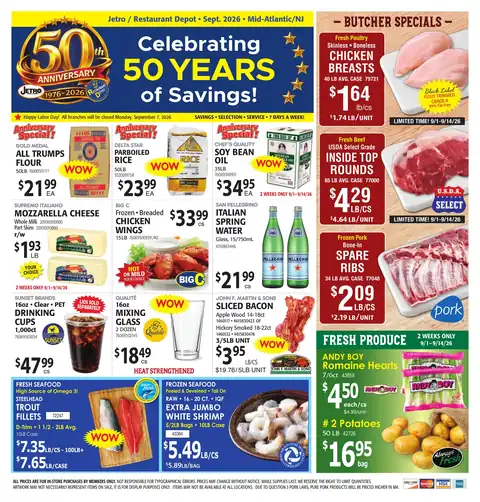
Restaurant Depot’s weekly promotional flyers—often distributed via email or accessible through their online portal—focus on high-volume, professional-grade inventory designed for foodservice operators. Unlike traditional grocery stores, these ads prioritize bulk pricing over individual unit discounts.
**Meat Department Deep Discounts: ** The most aggressive markdowns consistently appear in the meat and poultry sections. Shoppers typically find significant price breaks on full-subprimal cuts, such as Choice or Prime beef ribeyes, whole briskets, and pork loins. These items are sold in vacuum-sealed cryovac bags, and the weekly ad often features "case-ready" pricing that undercuts standard wholesale distributors.
**Produce and Pantry Staples: ** Weekly circulars frequently feature "Hot Buys" on high-turnover produce staples like 50lb bags of russet potatoes, cases of yellow onions, and bulk quantities of fresh herbs. In the dry goods section, the deepest discounts are applied to institutional-sized cans (No. 10 cans) of tomato products, bulk cooking oils (35lb jugs), and high-gluten flour.
**Customer Favorites: ** Regular shoppers prioritize the ad for seasonal equipment markdowns and bulk frozen goods. The most anticipated deals are the "Manager’s Specials" on frozen appetizers—such as breaded mozzarella sticks or chicken wings—which are highly sought after by restaurant owners looking to manage food costs during peak dining seasons. ### 2. The Restaurant Depot Difference and Exclusive Products Restaurant Depot operates as a true cash-and-carry warehouse, differentiating itself from consumer-facing retailers like Costco or Sam’s Club by requiring a business license for entry. This eliminates the "membership-lite" experience, creating a purely professional environment where inventory is stocked for back-of-house kitchen operations rather than home pantry storage. **Real Private-Label Brands:**
**Chef’s Quality: ** The flagship brand for Restaurant Depot, covering a vast spectrum of products from spices and canned vegetables to frozen entrees and cleaning supplies.
**Wholesale Pantry: ** A secondary private label focused primarily on dry staples, including grains, baking ingredients, and various shelf-stable condiments.
**Continental Choice: ** A brand often associated with higher-tier food items, including specific varieties of frozen seafood and specialty prepared foods. **Exclusive Product Examples:**
**Chef’s Quality No. 10 Canned Tomato Products: ** Professional chefs specifically visit Restaurant Depot for these because the sauce consistency and acidity levels are formulated for high-heat commercial pizza ovens and long-simmering pasta sauces, qualities rarely replicated in consumer-grade canned tomatoes.
**Whole Cryovac Subprimal Beef: ** Customers rely on the store for whole, untrimmed beef subprimals (like the full ribeye or strip loin). These are exclusive to the professional market because they allow chefs to dictate their own portion sizes and aging processes, a level of control not available with pre-cut supermarket steaks.
**Chef’s Quality 35lb Fryer Oil: ** This specific packaging format is a staple for professional kitchens. It is highly rated and anticipated because the jug design is engineered for the specific tilt-and-pour requirements of commercial deep fryers, offering a cost-per-ounce ratio that is physically unavailable in standard grocery retail.
Shopping Tips for Restaurant Depot
Restaurant Depot operates as a members-only wholesale cash and carry warehouse, meaning access is restricted to business owners who possess a valid resale certificate or tax-exempt status. Because the inventory is tailored for professional chefs and caterers, you should verify that your specific branch has the items you need in stock before making a trip, as product availability often fluctuates based on local demand and supply chain logistics. Unlike traditional retail chains, Restaurant Depot does not offer a public-facing loyalty program or standard consumer coupons, so the weekly ad serves as your primary tool for tracking wholesale price shifts on bulk commodities like proteins, produce, and commercial kitchen equipment. Always check the valid dates listed at the top of the flyer to ensure the pricing is current, as these deals are frequently updated to reflect volatile market rates for wholesale goods. When planning your visit, compare the unit prices featured in the ad against your regular operational costs to maximize your margins. Since inventory can vary significantly by location, use the store locator feature to confirm that the promotions you see on the digital ad are applicable to your nearest warehouse. Prioritize bulk purchases of shelf-stable pantry staples and high-volume ingredients highlighted in the ad, as these items typically offer the most significant cost benefits compared to smaller retail distributors.
About Restaurant Depot
Restaurant Depot is a members-only wholesale cash-and-carry foodservice supplier designed exclusively for independent restaurant owners, caterers, and non-profit organizations.
The company maintains a national presence with over 150 warehouse locations across the United States. Their inventory is tailored for high-volume commercial kitchens, featuring bulk-packaged food products, fresh produce, high-quality meats, seafood, and dairy, alongside an extensive selection of professional-grade kitchen equipment, smallwares, and janitorial supplies.
Their defining characteristic is the strict requirement of a business license for entry, which allows them to offer wholesale, tax-exempt pricing without the overhead of delivery services or minimum order requirements. This model enables professional operators to procure essential ingredients and equipment on-demand without the constraints of traditional broadline distribution contracts.
Where Does Restaurant Depot Operate?
Restaurant Depot operates over 150 warehouse locations across the United States. Key metropolitan areas served include:
Northeast: New York City (including the Bronx, Brooklyn, Queens, and Long Island), Newark, Philadelphia, Boston, and Providence.
Mid-Atlantic: Washington D.C., Baltimore, Richmond, and Pittsburgh.
Southeast: Atlanta, Miami, Fort Lauderdale, Orlando, Tampa, Charlotte, Raleigh, Nashville, and Birmingham.
Midwest: Chicago, Detroit, Cleveland, Columbus, Cincinnati, Indianapolis, St. Louis, and Minneapolis.
Southwest: Dallas-Fort Worth, Houston, San Antonio, Austin, Phoenix, and Las Vegas.
West Coast: Los Angeles, San Diego, the San Francisco Bay Area (including San Jose and Oakland), Sacramento, Portland, and Seattle.